
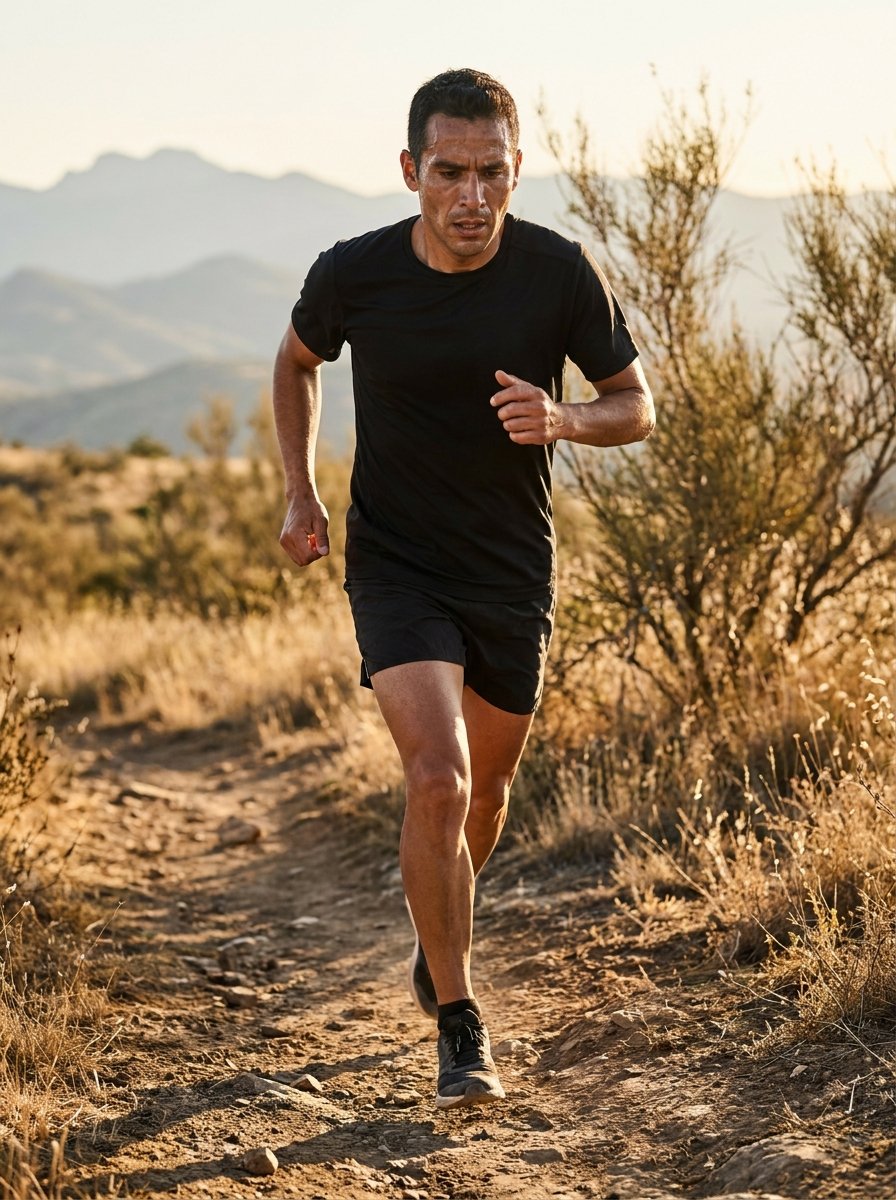
01The Molecule That Finds More Room in the Trained Athlete
Molecular hydrogen is the smallest molecule in the universe. It crosses membranes and reaches the myocyte mitochondrion, where the aerobic energy that a hill demands is produced. It selectively turns off the most damaging radicals (hydroxyl, peroxynitrite) without touching signaling useful for adaptation.
The Botek 2020 paper introduces an important nuance: the effect of H₂ on performance depends on the athlete's level. Why? The reasonable hypothesis is that the better-trained athlete has finer-tuned mitochondrial machinery, capable of taking better advantage of reduced oxidative damage. The less-trained athlete has more basic bottlenecks (technique, general aerobic capacity) that H₂ does not solve.
How do you obtain it? Fresh H₂ water from a medical-grade ionizer with negative ORP and dissolved concentration of at least 1.0 ppm. Pre-bottled bottles lose H₂ within hours and do not replicate the effect.
02The Study — What They Measured and What They Found
Botek and colleagues 2020 designed an open-label randomized trial (not double-blind — important to note; that is why it classifies as N3). Participants: 16 runners of different training levels. Intervention: 1680 mL of H₂ water peri-session during an uphill running protocol. Methodological note: because it is not double-blind, the results carry less weight than a strict N2. The main utility is informational, not as first-line evidence.
The Specific Measurements That Matter
Uphill-running performance: time and capacity to sustain intensity on hills. Key variable in mountain running, trail running, and popular races with elevation gain. Athlete-level categorization: grouping by personal best or maximal aerobic capacity.
The Results — What They Found Without Ambiguity
Performance benefit dependent on athlete level, with a greater effect in those better trained. It is a pattern also seen in other nutritional interventions: the tuned body has more capacity to take advantage of a selective tool such as H₂.
03How to Incorporate It — Step-by-Step Protocol for Uphill Runners
Get a Medical-Grade Ionizer
The trial used fresh H₂ water. You need an ionizer with medical certification that produces water with negative ORP and dissolved concentration greater than or equal to 1.0 ppm.
Apply the Peri-Session Protocol
Distribute 1680 mL around the session: 500 mL in the 30 to 60 min before, 500 to 750 mL during in sips for sessions of 60 to 90 min, 500 to 750 mL in the 1 to 2 h post window. For trail races with significant elevation gain, maintain the pattern.
Daily Base Hydration
2 to 3 liters daily outside the peri-session. For runners with high volume, heat, or altitude, raise to 3 to 4 L.
Combine with a Specific Hill Plan
Botek 2020 emphasizes that H₂ delivers more in tuned bodies. So combine it with a plan that includes specific hill work, leg strength, uphill stride technique, and adequate rest. H₂ does not compensate for poor programming.
04What to Expect — A Realistic Timeline
Session to Session
Better sensation on hills, less heaviness when closing uphill sets. If your level is intermediate-advanced, the effect is felt more quickly.
Block of 4 to 8 Weeks
If you sustain the peri-session and your plan includes hills and strength, capacity to absorb more hill volume without accumulating residual fatigue. That translates into better performance in races with elevation gain.
The Honest Note: If You Are a Beginner
If your level is very basic (less than 6 months running, no hill training), H₂ may help but it will not be dramatic. Your real bottleneck is building aerobic base and technique. H₂ will shine when that base is ready.
05The Honest Read — What H₂ Does and Does Not Do
Molecular hydrogen does not compensate for poor programming, deficient technique, or lack of aerobic base. The evidence (with the limitation that this trial was open-label, not double-blind) suggests that H₂ improves uphill performance, with a more marked effect in better-trained athletes. It is consistent with H₂'s selective mechanism. What IS consistent with the full literature: it does not blunt adaptation, it does not appear on WADA, it adds as a clean layer.